
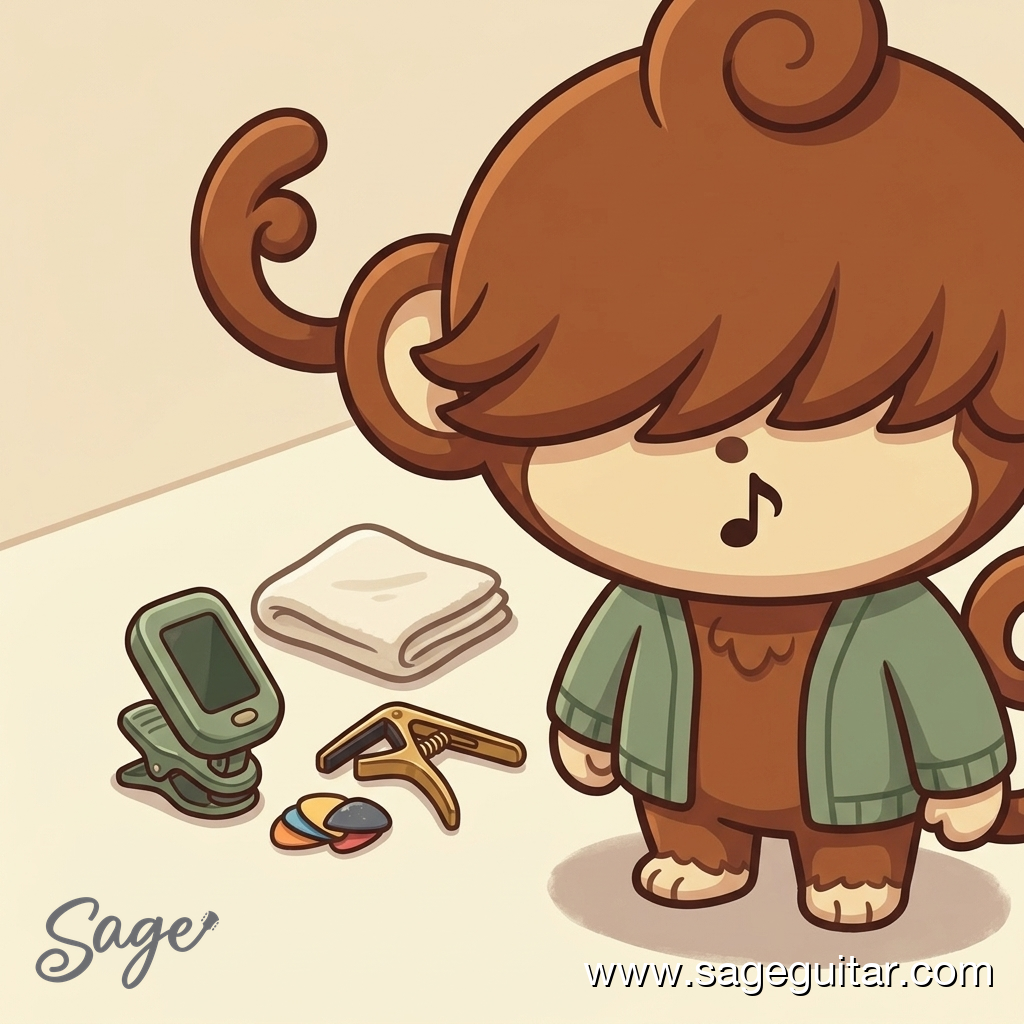
Getting your first guitar is exciting. But the guitar itself is really just the beginning. The accessories you pair it with on day one quietly decide how smooth — or how frustrating — those early weeks feel. Skip the tuner and you'll wonder why nothing sounds right. Forget spare strings and one snap ends your practice session. This list cuts through the noise and tells you exactly what to prioritise, and why.
1. A Clip-On Tuner — The Single Most Important Accessory
An out-of-tune guitar is the fastest way to make playing feel hopeless. Every note sounds wrong, chord shapes feel unrewarding, and your ear starts to doubt itself. A clip-on chromatic tuner solves this instantly. It clips onto the headstock, reads vibration directly from the wood, and works even in noisy environments — which matters when you're practising in a HDB flat with the fan running and a TV in the background.
Tuning apps on your phone exist, and they work decently in a quiet room, but a dedicated clip-on is faster, more reliable, and battery-sipping enough to last months. As a beginner, you should be tuning every single time you pick up the guitar. That habit trains your ear and ensures every minute of practice actually sounds like music.
- Clip it to the headstock before every session — make it a ritual.
- Check tuning again mid-session if you've been playing for 20+ minutes; new strings drift.
- Look for a chromatic tuner (not just guitar-specific) so it works as your playing evolves.
2. A Pick (or Three) — Because One Always Disappears
Picks are the socks of the guitar world. You buy them, you lose them, you find one behind the sofa cushion three months later. For beginners, a pick makes strumming cleaner and more controlled than a bare thumb, especially on steel-string acoustics where the strings have real tension.
Thickness matters more than most beginners realise. Very thin picks (0.46 mm range) are floppy and produce a bright, strummy sound — great for strumming open chords. Medium picks (0.73 mm) give you more control and are the most versatile starting point. Thicker picks suit single-note playing but can feel stiff for rhythm work early on. Start with medium, buy a small handful, and see what feels natural in your hand.
Material, shape, and brand are largely personal preference at this stage. Don't overthink it. The best pick is the one that doesn't feel like it's fighting you.
- Start with medium thickness (around 0.73 mm) — it's the most forgiving for beginners.
- Buy three or four at once; you will lose at least one.
- Keep a pick near your guitar stand or case so you never have an excuse not to play.
3. A Capo — Unlocks More Songs Than Any Lesson Will
A capo is a small clamp that attaches to the guitar neck and raises the pitch of all the strings at once. It sounds like a technicality, but in practice it's one of the most motivating tools a beginner can own. Why? Because most beginner-friendly chord shapes — open G, C, D, Em, Am — suddenly open up dozens of songs in different keys without learning a single new chord shape.
That song you love that sounds just slightly too high or too low to sing along to? Move the capo up or down a fret and it fits your voice perfectly. This is how real musicians work, and it's a genuinely useful skill to start building early. It also lets you play along to recorded music far more easily, which is one of the best ways to stay motivated in the first few months.
A decent spring-loaded capo doesn't need to be expensive to work well. What matters is that it clamps evenly without buzzing or pulling the strings sharp. A capo that wrestles with your guitar neck every time you use it will just put you off.
- Use it with a chord chart app to find the right fret position for songs you love.
- Try capo 2 or capo 3 when singing along — you may find chords suddenly feel easier to sing over.
- Check that it sits firmly and doesn't cause fret buzz before you start playing.
4. Spare Strings — Because Strings Break at the Worst Times
New strings break. Old strings go dull. In Singapore's humidity, strings corrode faster than you'd expect — the combination of air-conditioning cycling on and off and ambient moisture in most HDB and condo spaces accelerates oxidation on plain steel and wound strings alike. A spare set costs very little but saves your practice session (and your mood) when the inevitable happens.
For a steel-string acoustic, phosphor bronze strings are generally the preferred choice — they're warmer in tone and resist corrosion better than pure 80/20 bronze in humid climates. Lighter gauges (like 11s) are easier on beginner fingers and require less finger strength to press cleanly, which matters a lot in those early weeks when calluses haven't formed yet.
Sageguitar carries both Sage Phosphor Bronze and 80/20 Bronze strings in gauges suited for beginner acoustics — the phosphor bronze option is usually the better long-term choice for Singapore's climate.
- Keep at least one spare set in your gig bag at all times.
- Change strings proactively every 2–3 months even if none break — dull strings make learning harder.
- Wash your hands before playing; it's the single best way to extend string life.
5. A Gig Bag — Protects the Guitar and Makes It Portable
A gig bag is a padded, zippered case designed to carry your guitar safely. It's not as protective as a hard case, but it's far more practical for daily use — especially in Singapore, where you might be taking an MRT to a friend's place for a jam, or heading to a void-deck session on a weekend evening. A 3/4-size guitar in a gig bag is genuinely easy to carry on public transport; it fits in overhead bins and won't knock into people on escalators.
Even if you never leave home with your guitar, a gig bag protects the instrument from dust, knocks, and accidental humidity fluctuations when stored. Leaving a guitar propped against a wall or balanced on a chair is how headstocks get cracked and tuning machines get bent. A bag (or a simple stand) makes proper storage the path of least resistance.
Look for a bag with at least 10 mm of padding, a comfortable shoulder strap, and a small accessory pocket where you can stash your tuner, picks, capo, and spare strings. That pocket is underrated — everything lives in one place.
- Check that the bag is sized for your guitar — 3/4 bags won't fit a full-size and vice versa.
- Use the accessory pocket as your permanent home for tuner, picks, and capo.
- Even at home, bag or stand your guitar — it protects the instrument and keeps it in your sight line so you actually play it.
Why a Starter Bundle Is Usually the Smartest First Move
If reading through this list made you feel like there's a lot to think about — you're right, there is. That's exactly why a beginner bundle exists. Sourcing five accessories individually means five separate decisions, five chances to buy something that doesn't quite fit, and often a higher total cost than buying a curated set from the start.
A good bundle is put together with beginners in mind: the accessories are matched to the guitar size, the essentials are covered without overlap, and you can start playing from day one without a separate shopping list. It's the hawker-centre set meal approach — someone who knows the menu has already figured out what goes together.
The Sageguitar Beginner Bundle Set covers exactly the accessories above, paired with the right guitar for your size and playing goals. If you're not sure where to start, the Help Me Choose page can walk you through it in a few simple questions.