
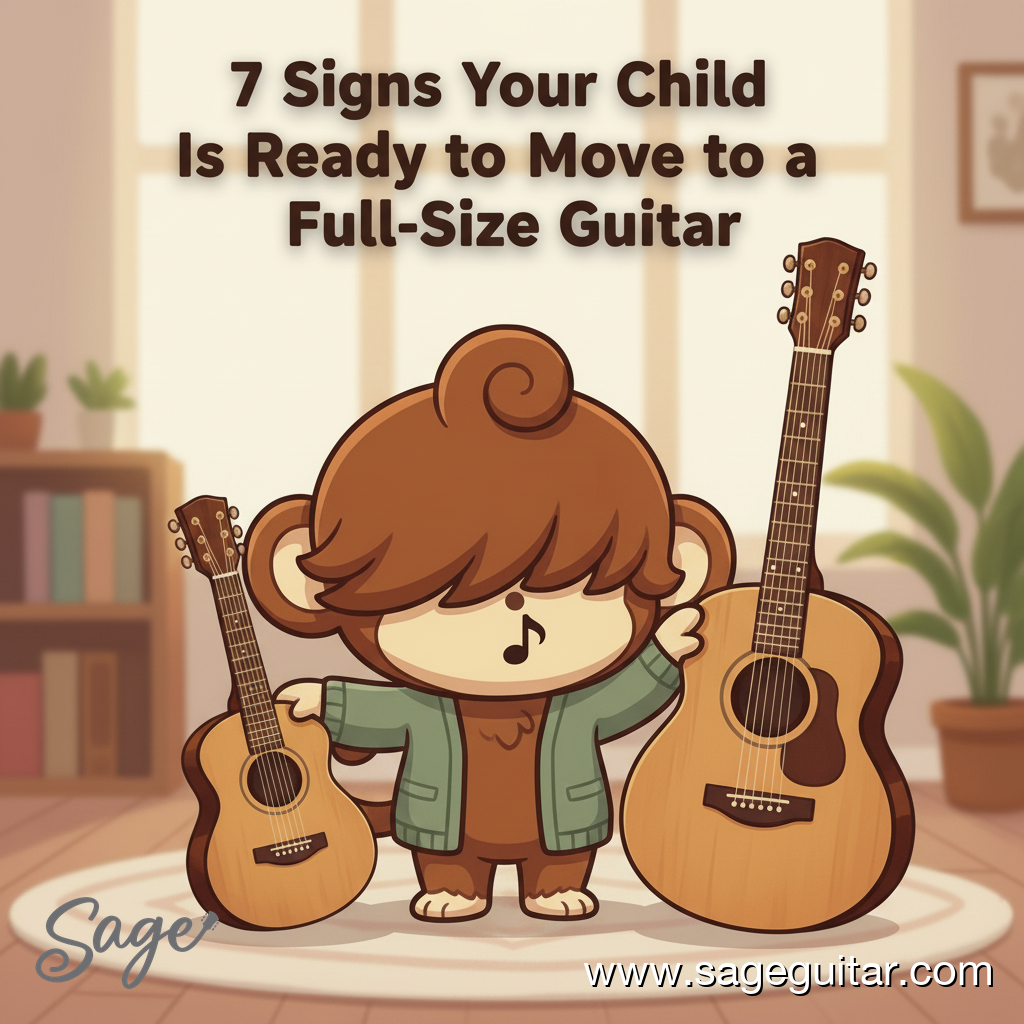
The 3/4 guitar is one of the best things to happen to young players. It's lighter, easier to hold, and far less intimidating than a full-size instrument. But kids grow fast — sometimes faster than we notice — and there comes a point where that same guitar starts to hold them back rather than help them along. Here are seven signs to look out for so you know exactly when the time is right.
1. Their Fretting Hand Feels Cramped on the Neck
A 3/4 guitar has a shorter scale length and a narrower neck, which is perfect for smaller hands. But once a child's fingers have grown enough to comfortably span a full octave, that compact neck can start feeling tight. You might notice them accidentally muting adjacent strings, or struggling to form open chords cleanly because their fingers are bumping into one another.
This isn't a technique problem — it's a sizing problem. When the instrument is too small for the hand, no amount of practice will fully compensate.
- Watch for fingers that look visibly crowded on the fretboard.
- Ask your child if their hand feels "squished" when playing a barre chord shape.
- Try having them rest their fretting hand on the neck without pressing — if it looks strained, it probably is.
2. Their Strumming Arm Overhangs the Body
Comfort isn't just about the left hand. The body of a 3/4 guitar is proportionally smaller, and when a child grows tall enough, their strumming arm ends up dangling awkwardly off the lower bout. Their elbow sits too far past the edge of the body, making it harder to anchor naturally and control their strumming motion.
Good tone and rhythm start with a relaxed strumming arm. If your child is contorting their posture just to sit the guitar comfortably in their lap, the body size is working against them.
- Check that the guitar body rests on the thigh without tilting forward or sliding.
- The strumming elbow should rest lightly over the upper edge of the body — not float in mid-air.
3. They're Playing Songs That Demand More Tonal Depth
A 3/4 guitar is a capable instrument, but its smaller soundbox naturally produces a lighter, brighter tone. That's charming early on. But as a child progresses — learning fingerpicking patterns, moving into lower register melodies, or simply playing longer with more dynamics — the tonal ceiling of a 3/4 becomes noticeable.
If your child is starting to complain that their guitar "doesn't sound right" when they compare it to what they hear on YouTube or at school, they may be hearing that size difference without knowing how to name it. That instinct is worth listening to.
- Notice if they're drawn to the lower strings more often in their playing.
- Listen for whether the guitar sounds thin or lacks warmth on the low E and A strings.
4. They Can Reach the Full Fretboard Without Stretching
Here's a simple physical test: ask your child to play a note at the first fret, then slide their hand up to the 12th fret without shuffling their seated position. On a 3/4, a growing child might find this almost too easy — their arm barely needs to extend. That's a sign the scale length is no longer a challenge for their reach; it's simply too short.
A full-size guitar's longer scale length will feel like a natural extension rather than a dramatic jump. When a child can navigate the full length of a 3/4 neck with ease, they're physically ready for more.
5. Their Teacher Has Started Dropping Hints
Guitar teachers see dozens of students at various stages. If yours has mentioned — even casually — that your child "might be ready for a bigger guitar soon," take that seriously. Teachers often notice sizing issues before parents do because they're watching technique up close every week. They can see when a student is compensating for an ill-fitting instrument with awkward posture or tension in the hand.
You don't have to wait for a formal recommendation. If you're unsure, just ask directly at the next lesson. A good teacher will give you an honest answer.
- "Is the guitar still the right size?" is a completely reasonable question to ask.
- If the teacher suggests a full-size, ask whether a 40" or 41" body would suit your child's frame.
6. They're Around 11–13 Years Old and of Average Height
Age alone isn't the best gauge — kids grow at wildly different rates — but it's a useful starting point. Most children between the ages of 11 and 13, and of average height for their age, are approaching or already within the range where a full-size guitar fits comfortably. In Singapore's school system, this often coincides with the upper primary to lower secondary transition, when musical interests also tend to deepen.
If your child is in this age band and has been playing for a year or more, it's worth doing a proper size check rather than assuming the 3/4 still fits. Growth spurts can happen quietly over a school holiday.
- A child above 150 cm tall is generally ready for a full-size guitar.
- Smaller or younger teens may still find a 3/4 more comfortable — height matters more than age.
- When in doubt, bring them in to try both sizes side by side.
7. They're Losing Motivation — and the Guitar Might Be Why
This one is easy to miss. When practice starts feeling like a chore, parents often assume it's a discipline issue. But sometimes, a child is subconsciously fighting an instrument that no longer fits them. Physical discomfort, a tone they find uninspiring, or the sense that their guitar sounds "babyish" compared to what older players use — these things quietly chip away at motivation.
Upgrading to a full-size guitar at the right moment can feel like a genuine milestone. It signals that they've grown, that their playing has matured, and that there's more to explore ahead. Sometimes all it takes to reignite enthusiasm is an instrument that meets them where they are.
- Talk to your child — ask if they still enjoy playing, and if the guitar feels comfortable.
- Notice if they play shorter sessions than before without a clear reason.
- Frame the upgrade as a reward for their progress, not a replacement of something broken.
Making the Switch
Moving from a 3/4 to a full-size guitar is one of the most meaningful moments in a young player's journey. It doesn't have to be stressful or expensive. Sageguitar's full-size acoustics — available in 40" and 41" — are built with beginner-friendly playability in mind, so the transition feels like a step forward, not a stumble. If you're still weighing your options or want a little guidance before committing, our help me choose page is a good place to start. You can also browse the full range at sageguitar.com/products.