
Need help choosing?
Use the blog to narrow the options, then jump straight into the product, bundle, or guide that fits the shopper best.
Answer-first articles that help beginners, parents, gift buyers, and returning players choose better, care better, and buy with more confidence.
Prioritize answer-rich articles that remove hesitation before checkout.
Use the Sage Guitar blog to answer buying questions quickly, compare options clearly, and move from advice into the right product or bundle.
Start with the real question the shopper already has, then move into the right guide, product, or bundle.
Mei from Bedok almost quit guitar on day 4 because of sore fingertips. Here's what actually happened over her first six weeks — and why she didn't stop.

Singapore's humidity is brutal on guitars. Here are 7 everyday HDB habits quietly wrecking your strings, tuning, and tone.

Mei from Bedok didn't know a single chord when her son asked for a guitar. Ninety days later, they're both playing.

Browse evergreen buyer-help, comparisons, and important updates.

For most beginners in Singapore, the best first guitar is a well set-up 3/4 or full-size acoustic priced roughly S$129 to S$175, sized to the player's age and reach rather than the cheapest option on the shelf. Kids aged 9 to 14 and smaller adults usually do better on a 3/4 guitar; teens and adults typically start on a standard 41-inch acoustic. Electric is a fine choice too if that's the music you love — just budget for a small amp.
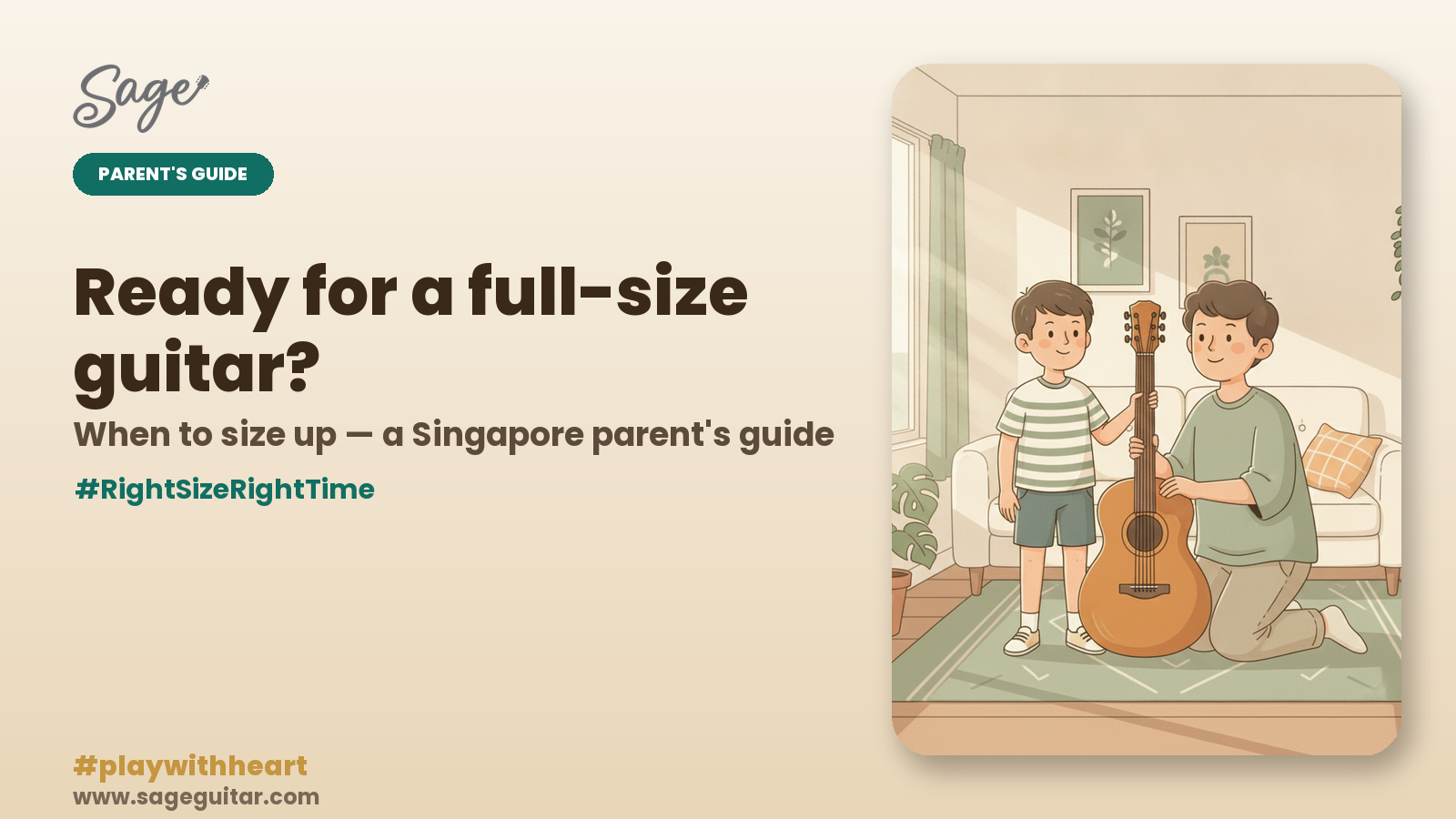
Most children are ready for a full-size guitar around age 11–12 or roughly 150cm tall — but comfort is the real test: if their arm wraps the body easily and the first frets are reachable without strain, they're ready. Until then, a quality 3/4 guitar builds skills faster than a too-big full-size.

For a Singapore primary school guitar CCA, most children need a correctly-sized beginner acoustic (usually 3/4 size for P1–P4), a padded gig bag, a clip-on tuner and picks — about S$100–175 total, or S$145–165 as a bundle. No prior experience is needed; check with the teacher whether the CCA uses nylon-string (classical) guitars.
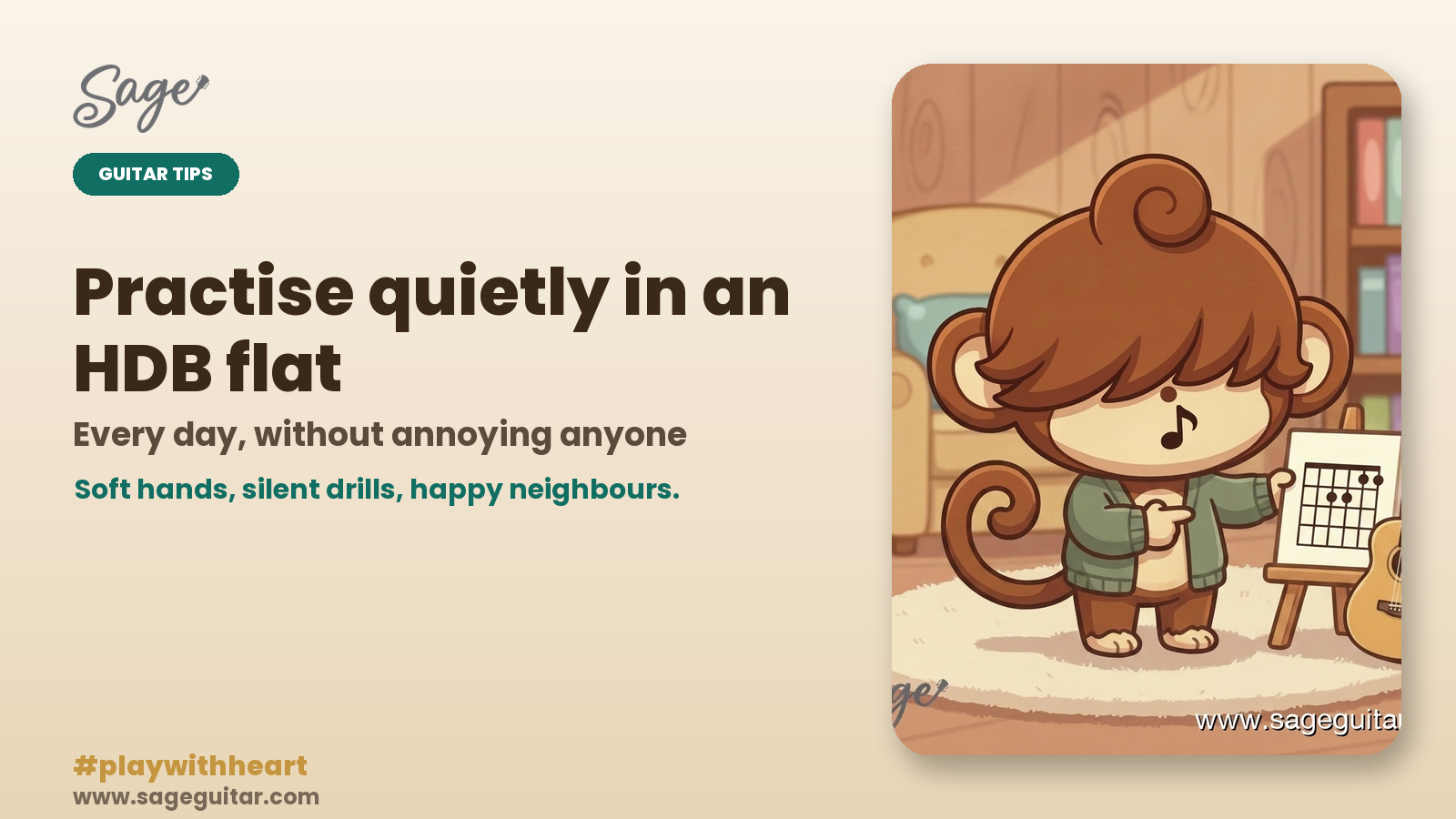
You can practise guitar quietly in an HDB flat by strumming softly with your thumb, doing silent fret-hand chord drills, using a cheap soundhole cover or string mute, and keeping louder practice before 9pm. A gently played acoustic is quieter than a TV — noise is the most over-feared obstacle in beginner guitar.

A beginner-friendly acoustic guitar — like a 3/4 size model with a bundle of essential accessories — is a low-risk, high-reward gift for skeptical Singapore families. Starting small reduces the financial pressure, the right size makes learning easier, and a complete bundle removes the friction of getting started. You don't need a guarantee they'll commit — you just need to make it easy to try.

A 14-day school holiday guitar practice plan for Singapore beginners: 15 minutes a day, split into two weeks. Week 1 covers chord basics and strumming; Week 2 focuses on playing a real song. Daily short sessions build muscle memory faster than occasional long ones, and a 3/4 acoustic is easy to carry around during the break.

No — you are not too old to learn guitar. Adults start successfully at 30, 40, 50, 60 and beyond. The brain keeps forming new connections for life, so what matters far more than age is a comfortable guitar, short regular practice, and a little guidance through the first month.

The cheapest and most effective beginner guitar upgrades are: replacing old strings with fresh phosphor bronze or 80/20 bronze strings, getting the action lowered by a luthier, cleaning the fretboard, checking nut slots, tuning consistently with a clip-on tuner, adjusting strumming angle, controlling humidity (especially important in Singapore), and recording yourself to identify tonal issues.

Fingertip soreness is normal for all beginner guitarists — steel strings press against soft, uncallused skin. The pain typically peaks in days 1–5, eases noticeably by weeks 2–3, and largely disappears by weeks 6–8 with daily practice of 15–20 minutes. Short, consistent sessions beat marathon practices. Calluses build through repetition alone; no shortcuts reliably speed the process.
Use the blog to narrow the options, then jump straight into the product, bundle, or guide that fits the shopper best.