
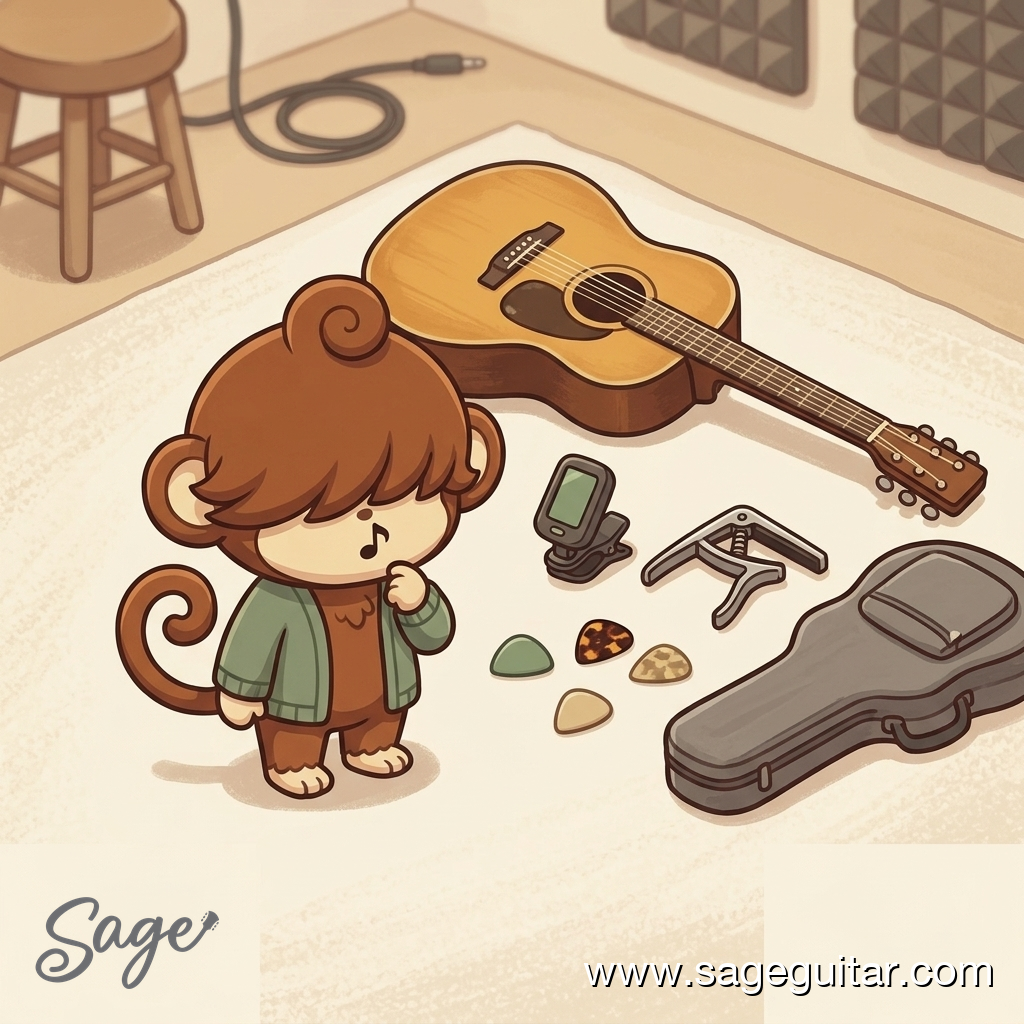
You've decided to learn guitar. Exciting. Then you open a shopping tab and suddenly there are picks, capos, tuners, bags, straps, and string sets staring back at you. What do you actually need on Day 1 — and what can wait until you've played for a few weeks? Here's an honest priority order for total beginners in Singapore, so your money goes where it helps most.
1. The Guitar — Non-Negotiable, Buy This First
This one is obvious, but worth stating clearly: everything else on this list is useless without a guitar in your hands. Don't delay the purchase waiting for the "perfect" setup. A decent instrument is all you need to start.
For most beginners in Singapore — especially younger players or anyone who commutes by MRT — a 3/4-size acoustic is a genuinely practical choice, not a compromise. It fits in an overhead compartment, takes up less corner space in an HDB bedroom, and is easier on smaller hands. If you're an adult with a full build and you're happy staying home to practice, a full-size 40" or 41" acoustic works just as well.
The key is to buy something purpose-built for beginners: properly set up, with strings light enough to not punish your fingertips in week one.
- Choose 3/4 size if you're younger, smaller-framed, or plan to travel with it.
- Choose full-size (40"/41") if you're a full-grown adult practising at home.
- Don't over-invest in your first guitar — spend just enough to get something reliable.
2. A Tuner — Buy This the Same Day
A guitar that's out of tune doesn't just sound bad — it actively trains your ears in the wrong direction. Beginners who practise on an out-of-tune guitar for weeks often develop habits that take months to undo. A tuner is, in that sense, a learning tool as much as a utility.
A clip-on tuner is the most beginner-friendly option: it clips to your headstock, reads vibration directly (so background noise doesn't throw it off), and costs very little. You don't need an app — your phone screen is harder to glance at mid-chord, and app microphones struggle in noisy environments like a living room with the fan on.
Make it a habit: tune before every single practice session. Singapore's humidity swings — especially going from an air-conditioned room to the rest of the flat — can shift your tuning more than you'd expect.
- Buy a clip-on tuner the same day you buy your guitar.
- Tune every time before you play, not just when something sounds off.
- Store your guitar away from direct aircon vents to keep it stable longer.
3. Picks — Buy a Few, Spend Very Little
Picks are cheap enough that there's no reason to skip them, but they're also not urgent in the way a tuner is. Many beginners spend their first few sessions strumming with their thumb — which is perfectly fine and actually worth doing early on to develop feel. Eventually though, picks give you more control over volume and attack, especially for strumming patterns.
The confusing part: picks come in soft (thin), medium, and hard (thick) gauges. For strumming beginners, a medium pick is the safest starting point — flexible enough for rhythm playing, firm enough that you're not fighting it. Buy a small handful; they disappear into sofa cushions and school bags at an alarming rate.
You don't need branded or "premium" picks at this stage. What matters is that you have something in your hand so you can experiment with feel.
- Start with medium-gauge picks for general strumming.
- Buy 4–6 at once — you will lose them.
- Try a few sessions fingerpicking too; it builds hand independence early.
4. A Guitar Bag — Buy This Before Your First Trip Out
If your guitar lives in one room and never moves, a bag is lower priority. But realistically, most beginners in Singapore will eventually carry their guitar somewhere — a friend's place, a lesson, a void deck jam session. That's when a bag earns its keep.
A padded gig bag (as opposed to a hard case) is the practical choice: lighter, easier to carry on public transport, and usually shoulder-strap friendly. For a 3/4 guitar especially, a well-fitted bag makes the whole thing feel easy to travel with. For full-size guitars, a bag is still far more manageable on the MRT than carrying the guitar uncased.
You don't need a heavy-duty touring case as a beginner. A solid padded bag with a back strap does the job for everyday use.
- Get a bag before the first time you plan to bring the guitar anywhere.
- Make sure the bag is sized to match your guitar (3/4 or full-size).
- A back-carry strap makes MRT trips noticeably easier.
5. A Capo — Buy It When You Need It, Not Before
A capo is a clamp that raises the pitch of all your strings at once, letting you play open chord shapes in different keys. It's genuinely useful — but it's the one item on this list that a total beginner can confidently delay.
In your first few weeks, you're building finger strength, learning chord shapes, and getting comfortable switching between them. A capo doesn't help with any of that. It becomes useful once you're playing songs and want to match a specific key, or when a song you love uses capo chords.
That said, once you're ready for one, don't overthink it. A spring-loaded capo works fine for acoustic beginners. You don't need a screw-type or a "partial" capo at this stage.
- Hold off on the capo until you're playing your first few full songs.
- When you do buy one, a simple spring-loaded capo is all you need.
- Think of it as a week-three or week-four purchase, not a day-one one.
The Short Version: A Sensible Buying Order
If you want it in one sentence: buy the guitar and a tuner on the same day, grab a few picks shortly after, get a bag before you travel, and pick up a capo when a song asks for one. That order keeps your spending purposeful and means every item you own is actually getting used.
If you'd rather sort it all out in one go, the Beginner Bundle Set is designed exactly around this logic — the essentials together, nothing you don't need yet. Or if you're still deciding between guitar sizes or types, the Help Me Choose page walks through it without any pressure.