
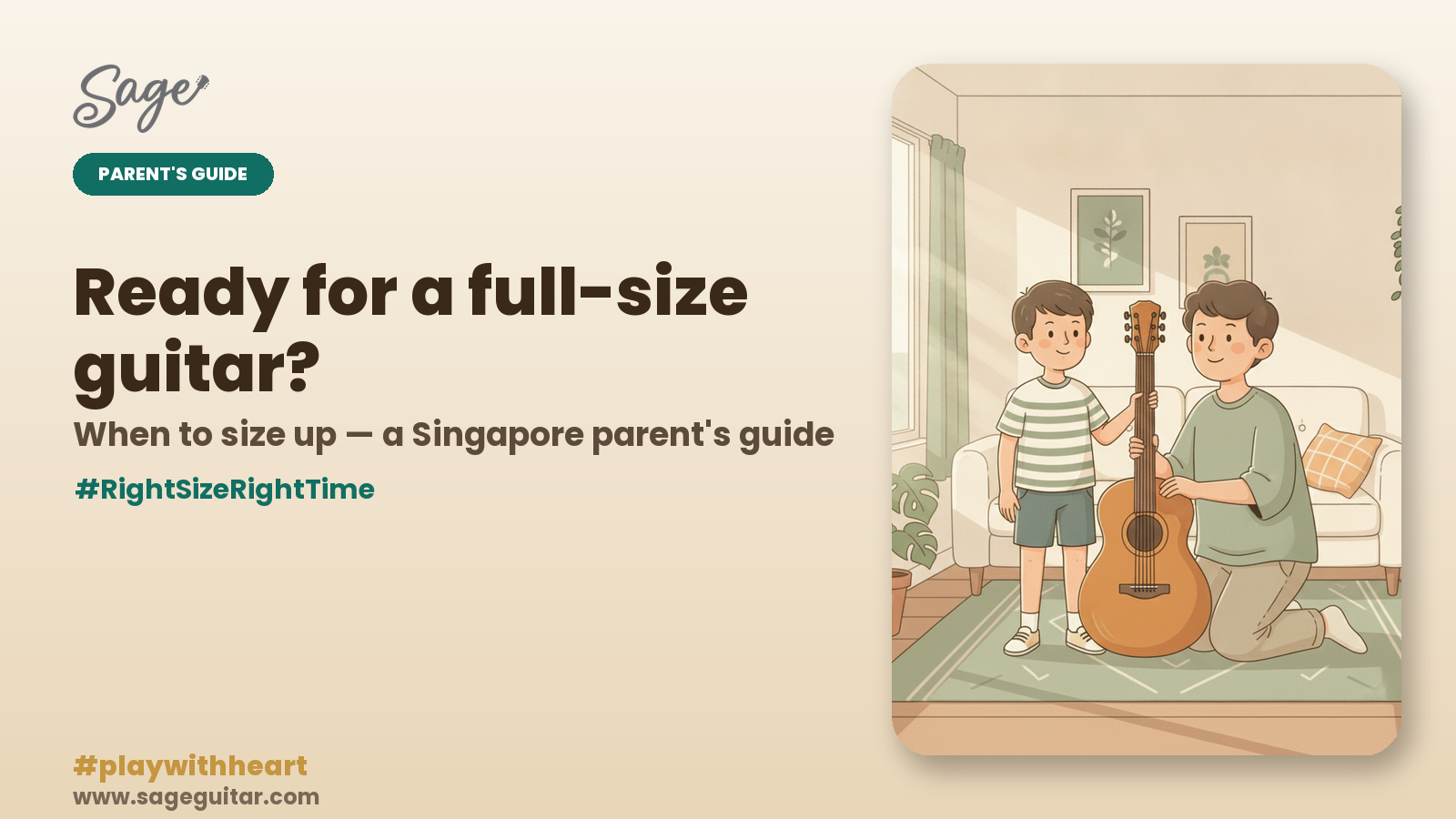
Quick answer: most children are ready for a full-size guitar around 11–12 years old or roughly 150cm tall — but the real test is comfort, not age. If your child can wrap their strumming arm around the body and reach the first frets without straining, they're ready. If not, a quality 3/4 guitar will serve them beautifully for another year or two.
If your child started on a small beginner guitar and is now shooting up faster than the price of kopi, you might be asking the big question: is it time for a full-size guitar yet?
It's a lovely problem to have. A growing child who still loves playing is exactly what we hope for at Sage Guitar. But sizing up too early can quietly kill that enthusiasm — a guitar that's too big becomes awkward, sore on the fingers, and frankly, no fun. Here's how to tell when your child is ready to move up, what "full-size" actually means, and how to choose without second-guessing yourself.
First, what counts as a "full-size" guitar?
Guitars are sized by fractions — 1/4, 1/2, 3/4 and full-size (often written as 4/4). These fractions don't mean the guitar is literally a quarter or half the size; they're traditional labels for how big the instrument is.
How many inches is a full-size guitar? A full-size guitar is typically around 38 to 41 inches in total length, depending on the body style. The number that matters even more for comfort is the scale length — the playing distance from the nut to the bridge. On a full-size guitar that's usually about 25 to 25.5 inches. A 3/4 guitar, by contrast, has a shorter scale (around 22–23 inches), which is why smaller hands find it so much friendlier.
- 3/4 size — great for younger kids and small hands; shorter reach, lighter body.
- Full-size (4/4) — the standard adult guitar size; longer scale, bigger body.
For a deeper dive into the numbers, our guitar size guide (36" vs 40" vs 41") breaks down every size we stock.
So what size guitar for an adult — and does that apply to my child?
Here's the honest answer parents don't always expect: most teens and adults play a full-size guitar. But the right size isn't only about age — it's about body size, arm length and hand comfort. A petite adult with smaller hands may genuinely be more comfortable on a 3/4 or slim-bodied guitar, and there's absolutely nothing wrong with that. Comfort beats convention every time.
Signs your child is ready to size up
You don't need a measuring tape and a spreadsheet. Watch for these everyday signals:
- They can wrap their arm comfortably around a full-size body without hunching or straining.
- Their fretting hand reaches the first few frets easily without over-stretching or wrist pain.
- They're playing regularly and starting to feel "cramped" on their current guitar.
- They've had a growth spurt — usually somewhere in the tween-to-teen years.
As a rough guide, many children are ready for a full-size guitar around 11–12 years old, or once they're roughly 150cm tall. But every child is different — treat this as a starting point, not a rule.
A simple at-home test
Sit your child down in playing position with a full-size guitar (or borrow a friend's for five minutes). Ask them to:
- Rest the guitar comfortably on their leg.
- Reach their strumming arm over the body.
- Press down a few notes near the top of the neck.
If they can do all three without contorting themselves, they're likely ready. If they look like they're wrestling the thing, give it a few more months on a smaller size. (Or pop by our Woodlands studio — we size children in two minutes, and it's honestly our favourite part of the job.)
Acoustic or electric for the next step?
Electric guitars often have slimmer necks and lighter string tension, which some growing players find easier on the fingers — even at full-size. That makes them a genuinely good option for kids stepping up, not just for aspiring rock stars. Beginner electric setups vary in price depending on brand and whether an amp is bundled — we'd always suggest trying in person rather than buying on specs alone. (Psst: electric guitars are arriving at Sage very soon. 👀)
Acoustic guitars, meanwhile, are wonderfully simple — no amp, no cables, just pick it up and play. For many families, that lower fuss keeps kids practising more often.
Don't rush the jump
Here's the most reassuring thing we can tell you: there's no prize for sizing up early. A child who's happy and comfortable on a 3/4 guitar will improve faster than one battling a full-size instrument that's too big for them.
If your child is still growing but has outgrown a very small guitar, a well-made 3/4 like our BabySage 3/4 acoustic can bridge the gap beautifully for a year or two. When the time is genuinely right for full-size, the move will feel natural — not forced.
Frequently asked questions
How many inches is a full-size guitar?
Around 38–41 inches in total length depending on body style, with a scale length of about 25–25.5 inches. The scale length is what your hands actually feel.
At what age should a child move to a full-size guitar?
Commonly around 11–12 years old or ~150cm tall — but comfort is the real test. If the arm wraps the body easily and the first frets are reachable without strain, they're ready at any age.
Can a teenager or adult play a 3/4 guitar?
Absolutely. Petite players often prefer 3/4 or slim-bodied guitars for comfort, and travel-sized guitars are popular with adults worldwide. Comfort beats convention.
Is an electric guitar easier for a child moving up?
Often, yes — slimmer necks and lighter string tension are gentler on fingers. The trade-off is needing an amp and cable. Acoustics stay the simplest grab-and-play option.
The bottom line
Watch the child, not the calendar: comfortable arm reach + easy first frets = ready. Until then, a quality 3/4 is the fastest road to progress. Unsure? Use our Help Me Choose quiz, browse our beginner guitars, or WhatsApp us at +65 8925 2625 — we'll size your child in two minutes, no obligation. 🎸
#playwithheart